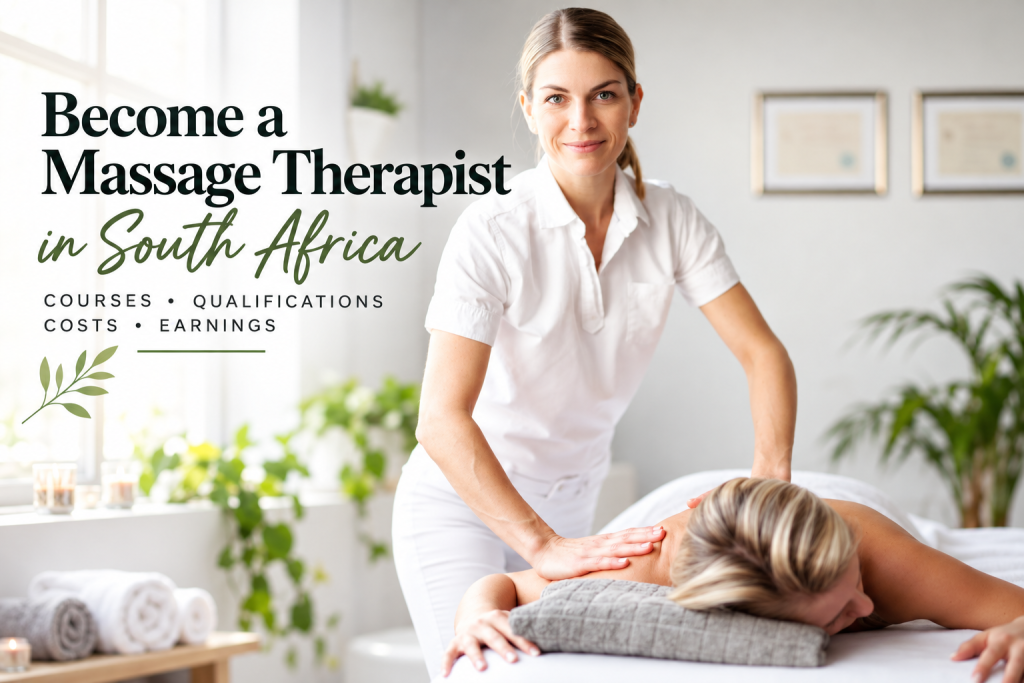

The Healing Touch: Dive into the World of Massage Therapy
Introduction: In a world where stress and muscle tension seem to be inevitable companions of our daily lives, finding solace and relief is crucial for

Have you ever considered becoming a massage therapist? Perhaps you love helping people feel better, you’re looking for a career change, or you’ve been thinking about starting a small business that gives you more control over your time and income.
Whatever your reason, massage therapy could be an exciting career path.
One of the biggest attractions of massage is that you don’t necessarily need to spend years studying before developing practical skills that you can use in the wellness industry. With the right training, dedication and hands-on experience, you can begin building your skills and working towards a rewarding career.
But where do you start?
How do you become a qualified massage therapist in South Africa? What qualifications do you actually need? How much does training cost? And perhaps the most interesting question of all: how much money can you earn?
Let’s answer these questions and explore why the Holistic Massage Certificate Course offered by CAMS Institute could be one of the best investments you make in your future.
The good news is that becoming a massage therapist can be more accessible than many people realise.
Unlike careers that require several years of university education, there are different training routes into massage, depending on the type of work you want to do.
For example, someone who wants to provide relaxation and holistic wellness massages may choose a practical certificate course, while someone who wants to practise regulated therapeutic massage therapy as an allied healthcare professional will need a different, more extensive qualification.
If your goal is to provide professional relaxation and holistic massage services, you can start by enrolling in a structured massage course that combines theoretical knowledge with practical training.
And this is where choosing the right course becomes especially important.
There’s a big difference between knowing a few massage movements and understanding how to give someone a genuinely professional massage experience.
Think about the last time you received an excellent massage.
What made it memorable?
Chances are, it wasn’t simply the pressure the therapist applied. It was the way they understood your needs, worked confidently, adapted their techniques and made you feel comfortable.
That’s what good massage training should teach you.
You need to learn about the human body, how muscles respond to touch, appropriate pressure, client consultation, hygiene, safety and when massage should be avoided or adapted.
Most importantly, you need enough practical experience to develop confidence in your hands.
At the Complementary & Alternative Medical Sciences Institute (CAMS), we believe that learning massage should be practical, accessible and focused on developing real skills.
Our Holistic Massage Certificate Course is designed for beginners who want to learn professional massage techniques, as well as existing wellness practitioners who want to expand their services.
What makes the course particularly attractive is that it introduces students to techniques drawn from four massage approaches:
Rather than learning just one basic massage routine, students develop an understanding of several complementary approaches that can be incorporated appropriately into holistic wellness massage.
These techniques form part of one comprehensive Holistic Massage Certificate Course; they are not four separate specialist qualifications.
The course also covers anatomy, indications and contraindications, client records, professional ethics, preparation, body mechanics and business skills.
In other words, we don’t simply want to teach you how to perform a massage. We want to help you understand what you’re doing, why you’re doing it and how to build confidence as a massage practitioner.
This depends on the qualification and training provider you choose.
Some formal qualifications require a year or more of study. Shorter skills-focused certificates can be completed much sooner.
At CAMS Institute, our Holistic Massage Course offers two convenient learning approaches.
In-class training: The practical course is structured around five weekly classes, providing guided instruction and hands-on learning.
Distance learning: Students who cannot attend classes can study using supplied learning materials, practical guidance and assessment requirements. The distance-learning pathway is designed around approximately three months, with flexibility to work through the material at a manageable pace.
We understand that many students already have full-time jobs, families or other responsibilities. Your training should fit into your life rather than requiring you to put everything else on hold.
Students receive hard-copy study material and access to our 24/7 WhatsApp student-support service.
Practical competence is an essential part of massage training, and students must complete the relevant practical requirements and assessments before receiving their certificate.
The result is a learning experience focused on developing knowledge, technique and confidence.
This is probably one of the most important questions to ask before enrolling in any massage course.
The answer depends on the type of massage you intend to provide and the professional role you want to pursue.
No.
For relaxation massage, spa massage and non-medical holistic wellness services, a university degree is not generally the standard entry route.
Many people enter this part of the wellness industry through practical certificate or diploma training.
However, prospective students should understand an important distinction between holistic wellness massage and regulated therapeutic massage therapy.
In South Africa, Therapeutic Massage Therapy is a regulated allied health profession associated with the Allied Health Professions Council of South Africa (AHPCSA). Registration in that profession requires the applicable recognised qualification and statutory registration.
A short holistic massage certificate does not replace those requirements or authorise someone to diagnose or treat medical conditions.
For example, the CAMS Holistic Massage Certificate is a skills-focused qualification for holistic and wellness massage. It is not an AHPCSA registration qualification or a SAQA-registered NQF qualification.
This distinction matters, especially when choosing your career direction.
If you want to work in the wellness and relaxation massage sector, a practical certificate may be an appropriate starting point. If your intention is to become a registered therapeutic massage practitioner, you should investigate the formal qualification and registration requirements before enrolling.
After successfully completing the required theory and practical assessments, students receive a CAMS Institute Certificate of Competence in Holistic Massage.
The certificate recognises that you have demonstrated the knowledge and practical competence required by the CAMS course.
CAMS Institute’s courses are internationally accredited through IETACH and the International Association of Therapists (IAOTH). CAMS also holds additional institutional and training-provider recognition through ACHH and ICAHP.
Successful graduates may be eligible to apply for professional membership of IAOTH or other applicable international associations, subject to membership requirements.
This provides an additional opportunity to develop your professional profile within the holistic wellness industry.
It is important to understand that international private-sector accreditation is not the same as South African statutory registration, nor does it automatically guarantee recognition by employers or authorities in other countries.
Nevertheless, obtaining relevant training and demonstrating practical competence can be an important first step towards building credibility with potential clients.
Completing a massage certificate can support applications for suitable wellness and spa positions, or help you develop an independent relaxation massage offering.
Possible career directions include working in a day spa, offering mobile massage services, providing treatments from a home-based studio, or adding massage to an existing beauty or wellness business.
Individual employers may specify additional qualifications, experience or practical assessments. International employers, including cruise lines, may have particular diploma and certification requirements.
For independent practice, you will also need to consider business compliance, insurance, suitable premises where applicable, hygiene standards and the scope of services you are trained to provide.
The advantage of massage is its flexibility. You don’t necessarily need to begin with a large salon or an expensive commercial property.
You could start small, build your experience, develop a loyal client base and gradually expand your offering.
And that brings us to a question almost every prospective student asks.
Massage course prices vary considerably.
You may find short workshops costing a few thousand rand, more comprehensive practical certificate programmes, and longer diploma courses costing tens of thousands of rand.
For example, some South African institutions advertise holistic massage training at over R10,000, while certain internationally examined diploma programmes can cost R20,000 to R40,000 or more, depending on their duration and content.
Higher fees can reflect additional training hours, broader qualifications or external examination costs. The most expensive option is not automatically the best option for every student’s goals.
The important question is:
What are you actually getting for your money?
Before enrolling, look at the content, practical training, support, assessment requirements, certification and whether the qualification is appropriate for your intended work.
At CAMS Institute, we believe professional skills training should be accessible to people who genuinely want to enter the wellness industry.
Our Holistic Massage Certificate Course is currently offered at a promotional price of:
R3,800 (normally R4,800).
That fee includes registration, supplied course material, the examination and certification.
Students also benefit from structured learning resources, practical guidance and access to our 24/7 WhatsApp student-support service.
And remember, the course introduces you to Swedish Massage, Sports Massage, Aromatherapy Massage and Lymph Drainage techniques within one programme.
For someone who is just starting out, that’s an attractive range of foundational massage skills at a comparatively affordable price.
You should budget separately for personal practical equipment, consumables or travel where applicable, and confirm any such requirements with CAMS before enrolling.
Consider the value of learning a skill that could potentially support a new career, an additional income stream or a small business.
Unlike many purchases that provide only short-term enjoyment, practical education can continue to be useful for years.
Once you develop a valuable skill, you have the opportunity to keep improving it through experience, additional training and professional development.
Of course, a certificate alone doesn’t guarantee clients or employment. Success also depends on your ability, professionalism, marketing and the quality of service you deliver.
But investing in the right training gives you a foundation from which to build.
For someone looking for an affordable entry point into holistic massage, CAMS offers a particularly compelling option.
Explore the CAMS Holistic Massage Certificate Course here.
Now for the question that often gets people excited!
Massage therapy can offer several ways of earning an income, and the amounts can vary significantly depending on whether you work for an employer or operate your own business.
According to Indeed’s South African salary data, the average base salary for a massage therapist was approximately R9,466 per month, based on 62 reported salaries and updated on 28 September 2026.
This is a useful general indication rather than a guaranteed salary. Earnings can vary by location, employer, experience, working hours, commissions and tips.
Someone starting out at a smaller spa may earn less, while an experienced therapist at a well-established business may earn considerably more.
However, one of the most interesting aspects of massage therapy is the possibility of working independently.
Let’s look at a realistic example.
In Cape Town, advertised prices for a 60-minute massage commonly fall around R400 to R600 at a range of established wellness businesses, although prices can be higher or lower depending on the location and treatment.
For our example, imagine you decide to charge R450 for a full-body massage.
If you see three paying clients per day, over 20 working days in a month, the calculation would look like this:
3 clients × R450 × 20 days = R27,000 monthly turnover.
That’s R27,000 in revenue from providing massage services.
Now imagine that, as you gain experience and develop an established client base, you are able to charge R600 per treatment.
At three paying clients per day over 20 days, your potential monthly turnover would be:
3 clients × R600 × 20 days = R36,000 monthly turnover.
That is not a prediction or guarantee. It assumes you successfully attract and retain enough paying clients to fill those appointments.
And importantly, turnover is not the same as profit.
You would still need to cover business costs such as rent, transport, oils, laundry, equipment, marketing, insurance and tax where applicable.
Nevertheless, the examples demonstrate why independent massage services can be attractive to people who want to build their own business.
Absolutely. In fact, the possibility of offering massage part-time is one of the reasons many people become interested in learning this skill.
You don’t necessarily have to resign from your job or open a full-time practice.
Imagine offering just two massages each Saturday and Sunday.
At R450 per massage, over four weekends, you could generate:
2 clients × 2 days × 4 weekends × R450 = R7,200 monthly turnover.
That’s the potential revenue from eight part-time working days, before expenses and subject to obtaining enough bookings.
For some people, massage could become an additional income source alongside their existing employment.
For others, it may eventually develop into a full-time business.
The real attraction is the opportunity to build something gradually.
You can begin with a modest number of clients, focus on delivering quality treatments, build relationships and grow as demand increases.
It’s tempting to think that the most successful therapists are simply the ones who know the most techniques.
But technique is only part of the story.
A successful massage business depends heavily on repeat clients.
Consider what happens when a client has an excellent experience. They may book another appointment, recommend you to a friend or purchase a treatment as a gift for someone else.
That means your ability to provide a consistently professional service is incredibly important.
People appreciate a therapist who listens, understands their preferences, makes them feel comfortable and delivers a treatment suited to their needs.
You also need basic business skills: pricing your services correctly, managing appointments, keeping records, communicating professionally and marketing your services.
This is why the CAMS Holistic Massage Course includes business-related subjects alongside practical massage techniques.
We want students to think beyond their first treatment and begin understanding the principles of building a professional service.
There are many massage courses available in South Africa, so choosing the right training provider deserves careful consideration.
At CAMS Institute, our approach is straightforward.
We believe massage training should be practical, supportive, flexible and affordable without compromising the importance of developing genuine skills.
Our Holistic Massage Course is one of our most popular programmes, designed to give students a broad introduction to professional massage rather than focusing on a single technique in isolation.
When you study through CAMS, you benefit from:
Whether you’re changing careers at 40, looking for a new direction after retirement, already working in the beauty industry or simply exploring a new opportunity, you’re welcome to begin your journey with us.
You don’t have to arrive knowing how to perform a massage.
That’s what the training is for.
What matters is that you’re prepared to learn, practise, improve and develop the skills needed to deliver a professional service.
Definitely.
Your first massage course can be the beginning of a much broader journey in wellness.
After developing your foundational massage skills, you may decide to specialise or expand the range of treatments you offer.
CAMS Institute provides additional courses such as Advanced Sports Massage, Indian Head Massage, Hot Stone Therapy and Aromatherapy.
For students interested in building a broader spa and wellness skill set, CAMS also offers a Spa Therapy Certificate Programme combining several complementary treatment areas.
This provides the opportunity to develop your knowledge gradually, according to your interests, professional goals and budget.
You don’t necessarily have to decide on your entire career path before starting your first course.
Sometimes, the best approach is simply to begin with a good foundation and see where your interests take you.
For the right person, massage therapy can be a very rewarding career.
It combines practical skills, human interaction, opportunities for continued learning and the possibility of flexible working arrangements.
It can also be personally satisfying.
There’s something special about providing a service that helps someone unwind, feel cared for and take time away from the pressures of everyday life.
Of course, massage is physical work. It requires stamina, sound technique, attention to safety and an ongoing commitment to professional development.
Starting a successful business also takes patience. Building a client base doesn’t happen automatically.
But if you enjoy working with people, take pride in providing a quality service and are prepared to put in the effort, massage could be an excellent skill to develop.
And you don’t necessarily need an enormous training budget to get started.
If you’ve been thinking about studying massage but haven’t taken the first step, perhaps now is the time to explore your options.
Whether your goal is to work in a spa, add massage to your existing wellness services, earn extra income part-time or build a small business, a practical Holistic Massage Certificate Course can help you establish an important foundation.
At CAMS Institute, we’ve designed our training to make that first step more accessible.
With a current course fee of just R3,800, flexible learning options, supportive guidance and a comprehensive introduction to several massage approaches, our Holistic Massage Certificate Course offers outstanding value for aspiring wellness massage practitioners.
Your next career opportunity could begin with learning one practical skill.
Discover what you could achieve with the right training, the willingness to practise and the confidence to take that first step.
View the CAMS Holistic Massage Certificate Course and Enrol Today
Complementary & Alternative Medical Sciences Institute (CAMS) — Learn. Get Certified. Build Your Future.
….share this article…..
Introduction: In a world where stress and muscle tension seem to be inevitable companions of our daily lives, finding solace and relief is crucial for
Have you ever considered becoming a massage therapist? Perhaps you love helping people feel better, you’re looking for a career change, or you’ve been thinking

Introduction: Joint pain can be a debilitating condition that affects millions of people worldwide. It can be caused by various factors such as arthritis, inflammation,